
This section will examine the phases that make up an anxiety process, learning to identify them more effectively and, consequently, regulate anxiety more efficiently.
The Rise
Initially, there’s a rising phase, where we begin to feel the changes that anxiety produces in the body: shortness of breath, chest tightness, increased heart rate, increased respiratory rate, nausea… These changes may not appear suddenly, nor is it necessary for all of them to appear. Learning to be aware that these changes are happening is crucial to begin regulating them in an early phase of anxiety. To do this, it’s necessary to pay attention to how I personally feel anxiety because, although it’s similar, not everyone experiences it exactly the same way, and being aware of your own process will allow you to understand it better and regulate it more easily.
The Plateau
Once anxiety has risen, a plateau phase is reached, where it remains stable for a few minutes. If we haven’t been aware of the process of increasing anxiety while it was rising, we will be here. This plateau is what most of us identify as anxiety itself: a moment where the main signs with which I react to anxiety are easily identifiable (also cognitive and behavioural, such as worry or physical agitation). This would also be a good time to carry out various emotional regulation strategies.
The Descent
If the anxiety cycle follows its natural course, after the plateau phase will come a descent phase, in which anxiety will gradually decrease until it eventually disappears. This descent phase is usually a little slower than the rise phase, and in it we notice that, either primarily or secondarily, anxiety remains present while we move. Emotional contact and work on acceptance will give us the foothold for this anxiety to continue its cycle, letting it decrease in the background while we carry out our regulation strategies.
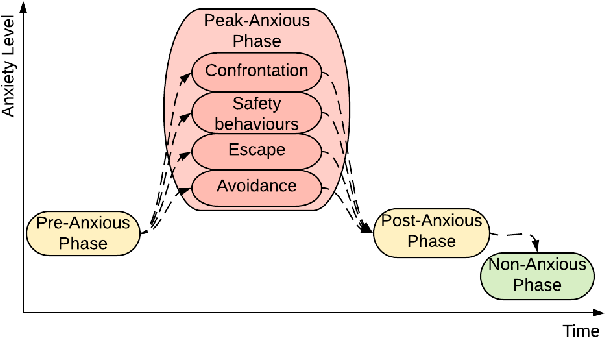
Detecting Temporal Phases of Anxiety in The Wild: Toward Continuously Adaptive Self-Regulation Technologies. Senaratne, H. 2019.
Conclusion
At a certain point, we will see how that anxiety has gone or, at least, has reached a point where it is manageable. It is now that we can consider resolving what was generating anxiety (if there really is something to resolve). This detail is important: anxiety is a basic, evolutionarily ancient physiological response. In today’s society, we will have moments when it is triggered in situations that are not really a danger to us. That is why here we can decide: do I really have something to solve? Was the reason why anxiety appeared really important? Do I have to solve it now, or can I leave it for later? In short, it is about deciding rationally if the reason why anxiety appeared represents a real problem that I have to face and, if so, whether the resolution of that problem should be immediate or not.
Deja una respuesta